$52.89
$71.41
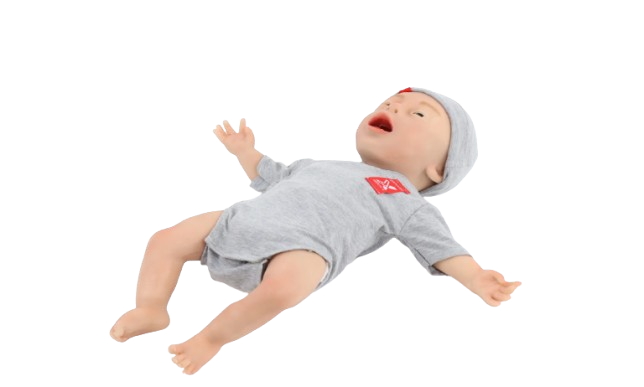
Description Mia is a completely wireless baby patient simulator that is highly realistic, both visually and tactilely. She is manufactured by SCALEO Medical in France. She offers the versatility of emulating patients that can be from full term newborn to about 8 months of age. Designed and crafted with a fine attention to detail, from the supple and seamless proprietary skin that feels natural to the touch, to palpable anatomical landmarks and a lifelike airway with true-to-life complications such as tongue edema, pharyngeal swelling, and laryngospasms. Technical Features: A heightened level of realism means fuller immersion in simulation training. With visible spontaneous breathing, palpable pulses, blinking, mouth and limb movements, monitoring of capillary refill time, programmable fontanel, auscultation sites (heart, lungs & bowel), and many other features, Mia can truly mimic a real baby. Changeable/programmable appearance: paleness, redness, jaundice, and cyanosis Vocal sounds (crying, grunting, hiccups, and many others)doma774_en_1_20230310_mia-patient-simulator A library of heart, lung, and bowel auscultation sounds Compatible with real mechanical ventilators and real defibrillators CPR assessment and feedback Sensors to monitor and record intubation procedures Change lung resistance and compliance to simulate different conditions IV access (umbilicus, wrist, scalp) and IO access (left/right tibia) Infant Resuscitation From assessing color, tone, breathing, heart rate, and chest movement, to delivering proper chest compressions and ventilation, Mia provides the feedback necessary for improving the quality of resuscitation. Wireless and mobile, she can transfer to the ICU for further treatment. Internal sensors record and monitor intubation procedures (orotracheal, nasotracheal, esophageal). Every action is wirelessly detected and logged in the software for subsequent debriefing. Key Features Wireless/Tetherless connection Palpable bone landmarks Head tilt/chin lift sensor and Jaw thrust Breathing patterns Oro/nasotracheal intubation Intubation sensor/depth sensor Airway complications(tongue edema, pharyngeal obstruction, laryngospasm) Programmable blinking Variable lung compliance, resistance Cyanosis, icterus, rubella, pallor Adjustable palpable pulse (Bilateral radial, bilateral brachial, bilateral femoral, umbilical, fontanel) Umbilical catheterization (UVC/UAC) continuous infusion and sampling. Umbilical pulses and movement of extremities Mouth movement Mechanical ventilation Measures properly on a Broselow™ tape Comes in different skin tones BREATHING Spontaneous breathing Respiratory rate is synchronized with vital parameters on the bedside monitor Programmable respiratory patterns Programmable diaphragmatic excursions Mechanical ventilation PEEP (up to 20cm H2O) Airways synced to the respiratory rate Variable compliance Variable bronchi resistance Audible needle decompression with realistic feedback AIRWAYS Realistic airways Supraglottic airway device support Head and jaw mobility Orotracheal and nasotracheal intubation Laryngeal mask airway insertion Pulmonary aspiration Positive pressure ventilation Dynamic airway resistance Neck hyperextension Airways obstruction Esophageal Intubation Feeding tube insertion BVM Cyanosis Chest rises and falls Bilateral bronchi resistance AUSCULTATION High-fidelity heart, lung, and bowel sounds Independent normal/abnormal heart sounds at mitral (1), aortic and pulmonic (2) sites 1 site for abdominal murmurs: normal/abnormal Korotkoff sounds auscultation while monitoring blood pressure Programmable bilateral chest rise and fall, synced with breathing NEUROLOGY Convulsions Programmable blinking Programmable muscle tone: active, decreased, hypotonia, lacking Programmable, palpable fontanel CPR Realistic chest compressions Automatic activity log, displaying all user actions Depth, frequency, hand placement assessment, and log Ventilation volume Manual configuration of CPR protocols Printable detailed CPR assessment VASCULAR ACCESS Intraosseous access (tibia, bilateral) Intravenous access (wrists, scalp, umbilicus) OTHER FEATURES Sounds: crying, screaming, coughing, moaning, grunts Sucking reflex Pre-installed themes, scenarios, and programs Realistic bone structure, palpable ribs, kneecaps, and many more Download User Manual Specifications Parameter Specification (typical) Age equivalence Full-term newborn (~0 kg) up to approx. 8 months age Height ~ 55 cm (21.5 in) Weight ~ 4 kg (9 lbs) Wireless battery life Up to ~6-8 hours continuous operation Attachment No harness – direct skin electrodes and sensors Scenario support Full range: airway, breathing, circulation, IV/IO, CPR
Internal Medicine